The ventilation index indicates how quickly and effectively smoke can leave an area. Open burning is only permitted if ventilation index conditions indicate smoke emissions will disperse.
Metro Vancouver provides a daily interpretation of the ventilation index for open burning. Changes in how Environment and Climate Change Canada provide the forecasts and collaborative work with BC Ministry of Environment and Parks have enabled a ventilation index to be provided for sub-regional zones in Metro Vancouver. The seven ventilation index zones each have their own forecast. These provide more locally specific information for your area than previously.
Municipal bylaws may prohibit open burning in your location. Contact your local fire department for information about municipal burn permits.
Daily ventilation index forecast
Updated daily | Last updated:
Map Zone
|
Municipality / Part of Electoral Area A
|
Ventilation Index / Burning Forecast for
|
|
Registered Under Bylaw 1355 |
Have an Open Burning Approval |
|
Zone map: 1 |
Location: Richmond, Delta, White Rock, Surrey, Barnston Island (EAA) |
Registered under Bylaw 1355:
|
Have an open burning approval:
|
|
Zone map: 2 |
Location: City of Langley, Township of Langley |
Registered under Bylaw 1355:
|
Have an open burning approval:
|
|
Zone map: 3 |
Location: Maple Ridge, Pitt Meadows, Coquitlam, Port Coquitlam, Port Moody, Belcarra, Anmore, east side of Indian Arm (EAA)
Details:
East side of Indian Arm includes Boulder Island, Hamber Island, and Carraholly Point |
Registered under Bylaw 1355:
|
Have an open burning approval:
|
|
Zone map: 4 |
Location: Lions Bay, Bowen Island, West Vancouver, Howe Sound communities and islands (EAA)
Details:
Howe Sound EAA communities include Ocean Point, Strachan Point and Montizambert Wynd, Bowyer Island, and Passage Island
|
Registered under Bylaw 1355:
|
Have an open burning approval:
|
|
Zone map: 5 |
Location: City of North Vancouver, District of North Vancouver, west side of Indian Arm (EAA) |
Registered under Bylaw 1355:
|
Have an open burning approval:
|
|
Zone map: 6 |
Location: Vancouver, Burnaby, New Westminster, UBC (EAA), UEL (EAA) |
Registered under Bylaw 1355:
|
Have an open burning approval:
|
|
Zone map: 7 |
Location: Northern Electoral Area A, including west side of Pitt Lake and northern end of Indian Arm |
Registered under Bylaw 1355:
|
Have an open burning approval:
|
Understanding the ventilation index
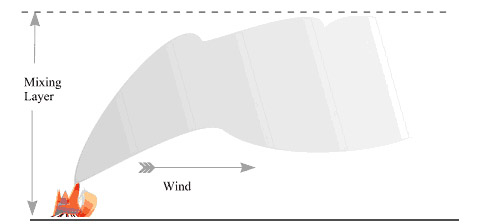
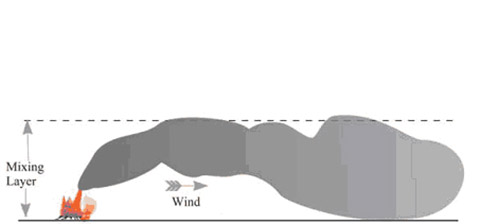
The ventilation index tells you how quickly and effectively the smoke will flush out of an area. The index is based on the wind speed and the thickness of the so-called "mixing layer" of the atmosphere.
Good ventilation index
Smoke rises quickly and/ or disperses rapidly.
Poor ventilation index
Smoke from chimneys or small fires tends to linger near the source or form a shallow trail that extends downwind.
Key terms and burning scenarios
The information below offers a simplified overview. If there is any discrepancy between this content and Bylaw 1355 or your open burning approval, then Bylaw 1355 or the approval, as applicable, take precedence.